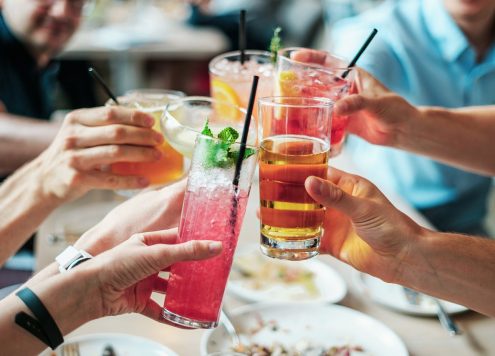
“The world is spinning, but I’m standing still!” I giggle to my slightly bemused friends.
I’m 14 and clutching a bottle of vodka to my chest, holding it close like a child with a comfort blanket. Around me, my friends dance like fireflies, sparkling in the light of the setting sun.
This is not my first experience of drinking-but it is my first experience of being drunk. I feel light and free and like I can conquer anything-anyone.
I march up to the group of boys that I desperately want to like me. Confident. Funny. Irresistible.
The next thing I know, my mother is dragging me to the car and my stomach is a nauseous mix of shame and neat vodka.
—
45 percent of 499 people I asked on Twitter were between 14 and 16 when they first got drunk.
If you live in the U.K.-or are even moderately aware of the stereotypes surrounding us Brits-this will not surprise you. It is practically enshrined in British law that teenagers must, at some point, sit in a park and drink Strongbow until they throw up. Practically every millennial in the U.K. has at least one story of drinking too much WKD at a house party and having to get picked up by their mum.
Drinking is normal here, to the point where having a thriving social life that doesn’t centre around booze is almost unheard of-at least if you believe Facebook and popular culture. Teenagers go to house parties, students go to clubs, and graduates graduate to cocktail bars. School mums plot to overthrow the PTA over three bottles of rose, businessmen discuss business deals over whiskey, and startups lure millennials in with free beer.
It’s just what we do.
—
I’m 15 and standing in my friend’s kitchen, watching a party happen around me. There’s glitter in my hair and on my cheeks, and the customary bottle of vodka (half-empty by this point) in my hands.
This time I do not feel light and free. I feel scared. Paranoid that everyone here secretly hates me.
Everyone seems to be on fast-forward, while I’m stuck in slow-motion. Girls dance and boys laugh and I take a gulp of vodka straight from the bottle, willing it to make me feel as sparkling as I look.
Minutes-hours?-pass, and I’m still standing there, wondering who would notice if I disappeared. I take another swig of neat vodka and run out the front door. Before I know it, I am barefoot and running down a pitch black country lane, with no idea where I am or where I’m going.
—
Fifty percent of the 242 people I asked on Twitter have felt some degree of pressure from their peers to drink.
This is not surprising either.
Whether it’s an automatic I’ll get you a glass of wine when you walk into a dinner party, or a raised eyebrow when you decline the third work social that month that revolves around alcohol, it’s clear that as a society we expect drinking. Encourage drinking. Demand it, even.
The pressure to drink-especially when you’re young-is so ingrained into us a society, that the entire millennial experience seems to be defined by alcohol. As students, drinking every night of the week is worn like a badge of honour. At work, we go for drinks with colleagues and acquaintances because we know that all the best networking happens over an overpriced cocktail in a dark bar. At weekends we flock to beer gardens with our friends to drink too much cider and smoke too many cigarettes.
Not drinking as a young person in Britain is likely to earn you the label boring. It may not be explicitly said, but when you regale tales of weekends spent walking around your local park and waking up at 9am on a Sunday with a clear head, people start to form assumptions about you. We label people as non-drinkers, as if the act of not blacking out every Friday night is noteworthy and unexpected.
We are a country of heavy drinkers.
—
The bonfire in front of me burns so fiercely and brightly and beautifully that I am captivated.
It’s 8pm and the party only started half an hour ago. I’m already a quarter of a bottle of vodka and seven jelly shots down. I’m laughing with a group of boys-men, practically-that I barely know. In fact, I know almost no one at this party, apart from my best friend, whose party it is.
I turn towards the fire, spellbound by the way it dances before my eyes.
When I awake the next morning-confused as to why I’m in my own bed and not my best friend’s spare room-I can’t see in colour.
I am 16.
—
Fifty nine percent of the 139 people I asked on Twitter have, at some point, blacked out from drinking.
But far from being cause for concern, blacking out is a sign of a good night. At university, my friends and flatmates would regularly congregate the morning (or afternoon) after a night out to piece together the evening, each of them filling the holes in the others’ memories. This was not treated with cause for concern-this was an integral part of the night out experience; of the student experience.
As a society, we think nothing of filling out bodies with so much ethanol that our brain erases entire hours from our lives. We expect it as part and parcel of a good night, and gleefully exclaim I can’t remember anything to our friends the next day.
And yet only 26% of people I asked on Twitter consider themselves or their friends to have a drinking problem. Because drinking problems are reserved for unshaved men drinking whiskey alone at 10am. Drinking is only a problem when it renders you unemployed and alone.
—
It’s the first night of Fresher’s, and I’ve downed two bottles of wine on an empty stomach.
I am fun and light and sparkling; free to start a new life. I am thrilled. I’m terrified. I drink more, before my new flatmates realise how dreadfully awful I really am.
That night, I get lost walking from the bar opposite my building to my room on the ground floor. I wake up with vomit on my new carpet.
—
It is, of course, possible and okay to drink alcohol regularly without having a drinking problem. It’s even possible to get drunk regularly and not have a drinking problem. Enjoying the taste of alcohol and the feeling of being moderately tipsy is a thing that many people do successfully.
But because drinking-and drinking heavily-is so normalised here that we laugh jovially at tales of starting a fight with bouncers because they told you off for vomiting on someone’s shoes, we rarely stop to consider what a drinking problem really looks like, when really we could probably all stand to inspect our drinking habits a little more closely.
Because drinking problems don’t always look like unshaved men drinking whiskey alone at 10am. Sometimes they look like happy-go-lucky university students having the time of their life. They look like that friend who downs a shot of vodka before daring to talk to the person they fancy. They look like a glass of wine with dinner, every single night without fail.
Sometimes they look like you and me.