Trigger Warning: This post contains descriptions of racism and violence, and the events in Charlottesville including references to Nazi language and symbology.
—
Charlottesville became household news over the weekend. It was broadcast to our front rooms. It was ingrained into our phones. It was on the mouths of our associates and it dominated social media.
The story that began to unravel in front of the watching world was as disturbing as it was chilling.
This is not what should be coming out of the leader of the free world, we thought. The events of the weekend and beyond were more akin to early mid-20th century America than 2017. It was horrifying—but sadly not surprising.
Charlottesville, a university town of some 46,000 people in the state of Virginia, USA started the weekend as such. But soon it became a focal point for abhorrent violence, with a state of emergency issued and reports confirming a minimum of three deaths and high numbers of casualties.
Friday night was where trouble began to rear its ugly head.
“A crowd made up of mainly men marched with flaming torches, as sheer anger and hatred engulfed them.”
In what has been described as one the ‘largest white supremacist events in recent US history,’ a Unite the Right protest was organised to demonstrate against the removal of a statue commemorating the Confederate figure of General Robert E Lee.
However, it was Saturday and the second day of protests that will have forced America to face its demons of yesteryear.
Protesting against the white supremacists, or Neo-Nazis as many suggest, counter-demonstrators of all different ethnicities and backgrounds clashed with the supremacist movement. Horrifying scenes ensued as violence flooded our Twitter and Facebook timelines, and at just shy of 13:42 local time, a Dodge Challenger vehicle rammed into the gathering counter-protesters, injuring many and killing Heather Heyer, a 32-year-old legal assistant and a prominent speaker for equality.
Amongst the images of fighting, Nazi salutes and tattoos depicting the Swastika were met with chants of “Heil Trump” from the nationalists. A crowd made up mainly of men marched with flaming torches, the beads of their eyes narrowed, as sherr anger and hatred engulfed them.
A man hits the pavement during a clash between members of white nationalist protesters against a group of counter-protesters in Charlottesville, Virginia, U.S., August 12, 2017. Joshua Roberts / Reuters
Many prominent activists and people in the public eye have spoken out against the events in Charlottesville, and Virginia’s governor tore into the supremacists.
He said: “I have a message to all the white supremacists and the Nazis who came into Charlottesville today. Our message is plain and simple: Go home. You are not wanted in this great commonwealth.”
NBA star LeBron James took to Twitter to condemn the violence, adding: “It’s sad what’s going on in Charlottesville. Is this the direction our country is heading? Make America Great Again huh?! He said that.”
“To say Britain is free from racial prejudice is misguided.”
Across the pond and back to us in the United Kingdom, we have always enjoyed a so-called special relationship with our counterparts in the US, largely through language and culture. But what do the events in Charlottesville mean for us here in the U.K?
Ironically, Saturday was the fortieth anniversary of the battle of Lewisham, where violence ensued after National Front protesters intended to march through Lewisham, but were met with fierce counter-protesters. The day was seen as an ultimate defeat for the far-right and a stride towards multiculturalism.
Of course, we have white supremacist groups today; the English Defence League, British National Party, and National Action are still working in the shadows of society and are all examples of such. But these are not AK-47 toting, flame wielding organisations. No, they are just a collective of idiots who feel as if they entitled to something or other as life has done them wrong. Thankfully, in modern day Britain they are often laughed out of cities, as has been seen in Liverpool and Manchester.
Crowds gather at Clifton Rise on 13 August 2026 during the Battle of Lewisham. Photo: Chris Swartz
Nevertheless, to say Britain is free from racial prejudice is misguided. America, when descending towards racial hate, seems to justify it by stating the constitution and the right of free speech. Britain, on the other hand, points to recent events such as the Brexit vote, arguing that the people have spoken and they ‘want their country back.’
But whilst we do not have election rallies that are met with chants of “BUILD THE WALL”, we do have racism here in Britain—it’s just not necessarily as overt as it is in the states. It is, however, equally toxic.
“Until racial tensions are spoken about, the boiling tensions could soon erupt into a Charlottesville-like episode here in the UK.”
People harbour intolerance, and whether it is the question of “why are you brown?” at school or the need of a BAME person to alter their appearance and persona to fit a job criterion, intolerance needs to be addressed.
We have literally had a referendum that attempted to tap into the desires of British nationalism, where a campaign poster depicting migrants mimicked one seen in Hitler’s Germany.
As a black man witnessing the goings-on in Charlottesville, it is deeply unsettling to see that white supremacist can be held in today’s society. Simply, they are born out of pure hatred.
As a history undergraduate also, who has studied the workings of Nazi-Germany, there should be NO place for its disgusting ideals to breed. I have always said I see Adolf Hitler not as a person but as an entity born out of the hatred and intolerance of the public. It seems that Donald Trump is the same.
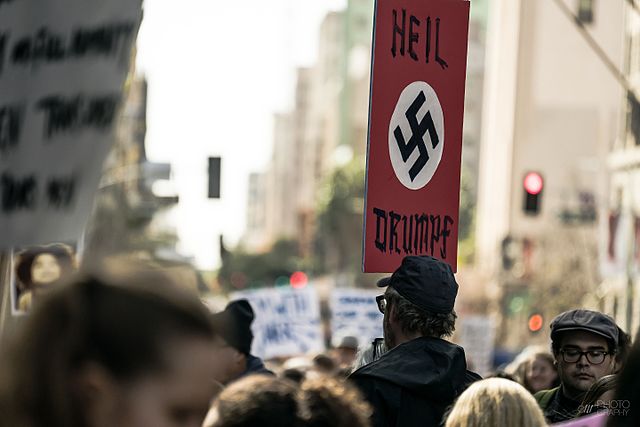
Allied soldiers of all races braved the beaches, the landing strips, and the front to ensure ideologies like Nazism would be eradicated-and this needs to be upheld.
For America, given their history with racism, the most appropriate way of summarising the events that have unfolded is a child, no more than three, wearing a KKK outfit as he approached a police officer.
For Britain, we can certainly seek solace in the fact that racism does not lead to mass instances such as Charlottesville. But, like everywhere, we have problems, and until these problems are tackled or even spoken about, the boiling tensions could soon erupt into a Charlottesville-like episode here in the U.K.
—
Featured image by Evelyn Hockstein for the Washington Post/Getty Images.